Veranstaltungen
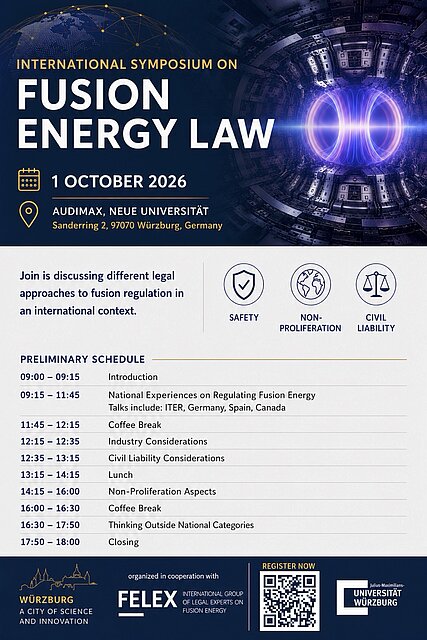
International Symposium on Fusion Energy Law
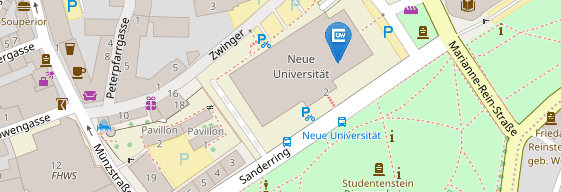
on 1 October 2026 in the Audimax at the New University of Würzburg, Sanderring 2, 97070 Würzburg
Fusion – the energy source of the future? This year, the focus will be placed more firmly on the legal framework, whilst also incorporating an international perspective.
Speakers will include international experts from the fields of regulatory practice, academia, industry and civil society.
If you would like to attend, you can register directly for the International Symposium on Fusion Energy Law here.
You can find the full lectures from the lecture series ‘Fusion Energy and its Legal Issues’ on YouTube.
In his introductory lecture, Dr Philipp Sauter introduced us to the fundamentals of fusion and then explained the role, work and objectives of the ‘Young Researchers’ Group on Legal Issues in Fusion Energy’.
Fusion is the process by which two light atomic nuclei merge to form a heavier nucleus, releasing energy in the process. Dr Sauter emphasised the importance of regulatory frameworks for the advancement of fusion. In addition to conducting cutting-edge research in this field, the Young Researchers’ Group also aims to establish a national and international centre of excellence for fusion energy, to act as a point of contact, to provide advice and to facilitate networking amongst the various institutions involved.
You can find the presentation from Dr Philipp Sauter’s opening lecture here!
In her presentation on the ‘Nuclear Fusion in Bavaria’ mission, Mona Augustin from the Bavarian State Ministry of Science and the Arts outlined the aim of establishing Bavaria as a leading centre for fusion energy. Bavaria’s master plan includes strengthening research and teaching, as well as building up expertise and expanding cooperation. At the same time, the focus is on providing equal funding for magnetic fusion, laser fusion and hybrid approaches, and a commission of experts is being set up.
The commission will make recommendations on the priorities, focus and appointments for new professorships, as well as early-career research groups (including an early-career research group on legal issues relating to fusion energy). In future, up to eight new professorships and thirteen early-career research groups are to be established.
From 2026 onwards, the recommendations of the expert commission are to be implemented and incorporated into the federal government’s fusion strategy.
The federal government’s aim is to make Germany the leading centre of innovation for fusion technology (the so-called ‘High-Tech Agenda for Germany’). The first fusion power plant, including ‘no-regret measures’, is due to be operational by around 2045. Key challenges in this regard include materials, tritium, plasma and laser control, and regulatory frameworks.
In his lecture, “Physical Aspects and Implications for the Safe Operation of Fusion Power Stations”, Prof. Mannheim explained the physical advantages and underlying principles of fusion.
He began by emphasising that there is a steadily rising demand for electricity due to GDP growth and AI data centres. Fusion energy, however, is regarded as a resilient base-load supply within a hybrid energy system, alongside renewable energies.
At the physical level, too, there are numerous hurdles to overcome, such as tritium breeding, thermal design, neutron activation and real-time plasma control.
The conditions for industrial-scale deployment are being created through “public-private partnerships”.
So-called spill-over technologies play an important role, such as high-temperature superconductors, high-power laser optics, vacuum technology, radiation-hardened electronics and diagnostic systems, robotic maintenance, and plasma control for various applications.
Prof. Mannheim emphasised that consideration must be given to nuclear chemical facilities on the periphery of fusion power stations and the risks they pose. These are essential for the isotopic processing of fuels and breeding materials, the storage and transport of short-lived radioactive isotopes, and the transmutation of radioactive spent fuel.
The risk of proliferation is equally significant. High development costs coupled with uncertain capital expenditure (CAPEX) would entail a high economic risk, which could be mitigated through the utilisation of spill-over technologies.
In his presentation, Dr Hans Lückhoff discusses ideas for transforming the Biblis nuclear power station into a ‘fusion campus’.
Biblis was shut down in 2011 following the Fukushima nuclear disaster and is currently being decommissioned, a process expected to continue into the 2030s. A feasibility study identifies significant cost benefits in reusing the existing site for facilities dedicated to nuclear fusion research. The start-up Focused Energy intends to build the world’s first laser fusion power plant there.
However, the legal framework is not yet fully clarified. The Atomic Energy Act (Section 7(III)(4) AtG) generally stipulates the immediate decommissioning of decommissioned facilities. Several scenarios are conceivable as to how this decommissioning obligation could be fulfilled through conversion into a fusion power station. In addition, any liability issues must be clarified, taking into account the ‘polluter pays’ principle and the risk of the site becoming an industrial wasteland in the event of the operator’s insolvency. Despite considerable legal uncertainty, there is significant political scope for action. Clear statutory provisions, as well as a political assessment of risks and opportunities, will be required.
Kristin Weiß compares the legal frameworks for fusion energy in Germany and the USA, whilst also examining international regulatory approaches in Japan, France and the United Kingdom. Despite the lack of uniform international regulatory approaches, a trend can be observed towards regulating fusion outside the traditional nuclear fission framework.
In Germany – without any change to the law – fusion is already subject under current legislation to the Radiation Protection Act (StrlSchG) and not to the Atomic Energy Act (AtG), as the fuels used (deuterium and tritium) are not regarded as nuclear fuels within the meaning of these Acts. The StrlSchG requires a three-part licence for fusion facilities covering their construction and operation, as well as the associated handling of radioactive substances. The USA also regulates fusion outside the nuclear fission regulatory framework and adopts a material-based approach, whereby the radioactive material used and produced in fusion facilities is subject to regulation by the US Nuclear Regulatory Commission (US NRC) as ‘by-product material’.
Despite a similar basic approach, differences are apparent: whilst in Germany fusion legislation is enacted uniformly at federal level in accordance with Article 73(1)(14) of the Basic Law, the US legal system, through the so-called National Material Programme, affords individual states scope for setting their own regulatory requirements. Whereas in Germany fundamental regulations – particularly those relating to fundamental rights – must be enacted by the parliamentary legislature, US fusion regulation is characterised by administrative rule-making by the US NRC – a practice unfamiliar to German law in this form.
You can view Kristin Weiß’s presentation on fusion energy in a comparative legal context here!
Dr Raetzke discussed the legal regulation of nuclear fusion during the transition from research to industrial application, against a backdrop of international competitive pressure. Fusion facilities in Germany are currently subject to the Radiation Protection Act (StrlSchG), which requires specific licences for construction, operation and the handling of radioactive materials. Key requirements include technical safety in line with the current state of science and technology, a waste management plan and a financial provision of 25 million euros.
A key pillar of the regulatory framework is the ‘Graded Approach’, whereby requirements are tailored in proportion to the actual radiation risk posed by the respective facility. Since 2025, the ‘ReFus’ pilot project has been developing a flexible, technology-neutral regulatory framework designed to evolve in parallel with the technical development of the first facilities.
In future, a standalone ‘Fusion Act’ or amendments to the Radiation Protection Act (StrlSchG) could also address issues such as the transition of former nuclear power plant sites in a legally sound manner. The authorities are required to adopt a ‘constructively critical stance’ in order to guarantee safety whilst at the same time enabling technological progress. In addition, the use of ‘real-world laboratories’ is being examined to test innovative monitoring and verification methods under real-world conditions.
In his presentation, Wolfram Tonhauser (Chairperson, FELEX) discussed FELEX (International Group of Legal Experts on Fusion Energy) and the IAEA (International Atomic Energy Agency) in the context of fusion energy.
FELEX was founded in 2023 as an independent group of experts to provide specialist knowledge on the legal and regulatory aspects of the peaceful use of fusion. The group currently comprises 16 members and 16 ‘observers’, including representatives from the IAEA, the European Commission, the ITER Organisation and the Young Researchers’ Group on Legal Issues in Fusion Energy at the University of Würzburg.
FELEX is currently the only group dealing comprehensively with the legal issues surrounding fusion energy. In future, FELEX’s research will focus on third-party liability, expert inspections, public acceptance and the harmonisation of legislation.
The IAEA is a global organisation with 181 member states, headquartered in Vienna. It is headed by Director General Rafael Mariano Grossi. It plays a crucial role in setting technical standards, adopting legal instruments under the auspices of the IAEA, and concluding international treaties within the nuclear legal framework.
.You can watch Wolfram Tonhauser’s presentation on this topic here!